/ PLN
/ PLN
In common understanding, when users talk about controllers in active-active arrays, they mean that both controllers work simultaneously and handle I/O traffic at the same time.
They expect the array to automatically distribute the load across both controllers, which translates to better performance and higher reliability. In the event of a controller failure, the second one immediately takes over all traffic without any interruption in data access, so users and applications do not notice any disruptions.
Users also often assume that hosts can use both paths to the array, and failover is completely transparent to systems and applications.
In practice, it is not always this ideal, because the operational details depend on the specific array architecture and environment configuration, but this is exactly how the concept of active-active is most commonly understood in the context of array controllers.
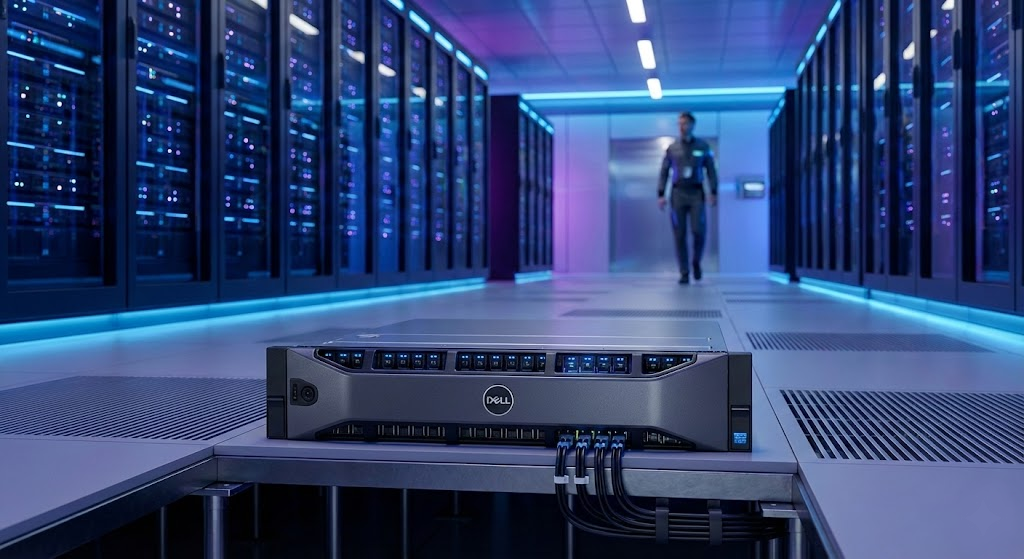
Active-Active in Dell Arrays – How controllers handle I/O operations
The architecture of controllers in storage systems is crucial for performance, availability, and fault tolerance.
In particular, the active-active mode is often perceived as a guarantee of high availability, but its implementation can vary significantly depending on the device class.
In Dell PowerVault ME5, Unity XT, and PowerStore arrays, three different approaches to assigning I/O operations to controllers have been applied, which affects how the entire system operates.
1. PowerVault ME5 – Controller activity with limited parallelism at the volume level
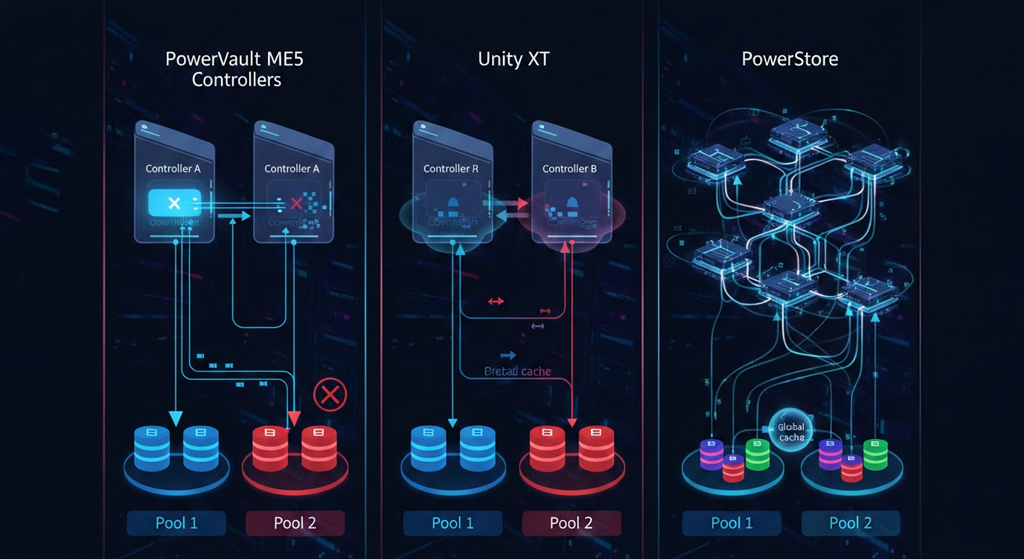
In the case of Dell PowerVault ME5, we are dealing with a dual-controller active-active architecture, which, however, does not mean full data processing parallelism. Although both controllers are active, they do not dynamically distribute the load for I/O operations concerning the same volume. Parallelism does exist, however, at the level of the entire array – if disk pools are divided between controllers, the volumes assigned to them can be handled simultaneously, each by its own controller.
Unlike more advanced solutions, in ME5 the assignment does not apply to a single volume (LUN), but to the entire disk pool. This means that all volumes created within a given pool are assigned to one of the two controllers as their "owner". All I/O operations for these volumes are directed exclusively to the assigned controller. The second controller remains active but serves a standby role, taking over operations only in the event of a primary controller failure.
Such an operational model, while ensuring high availability through an automatic failover mechanism, does not allow for dynamic load balancing between controllers. In practice, this means that one controller can be overloaded if it handles an intensely utilized pool, while the other remains unutilized. Moreover, the pool assignment to the controller is static and does not change automatically in response to load changes. This limitation makes ME5 unsuitable for environments with high load variability or those requiring intensive data processing, where real-time I/O balancing is crucial.
2. Unity XT – Preferred controller and partial parallelism
Dell Unity XT also uses two controllers in active-active mode, but in a more advanced way than ME5.
Each LUN is assigned a "preferred" controller, to which I/O operations are directed by default. Unlike ME5, the second controller is not just a standby; it can actively participate in handling data, especially in situations of overload or failure. This mechanism allows for partial load balancing and better resource utilization, although we still do not have full freedom in assigning I/O operations to any controller. Failover is fast and automatic, and the system can dynamically respond to load changes, which makes Unity XT a more flexible solution for production environments
3. PowerStore – Full parallelism and dynamic I/O assignment
The most advanced approach to active-active architecture is presented by Dell PowerStore.
In this model, a containerized scale-out architecture is used, where each node (controller) can handle I/O operations for any LUN, without owner assignment. This means that data can be processed in parallel by multiple controllers, and the system autonomously decides which node will best handle a given operation. Thanks to the global cache, PowerStore can dynamically balance the load between nodes, which translates into maximum performance and optimal resource utilization. Failover is fully automatic, and the migration of volumes between controllers happens without downtime. This approach eliminates bottlenecks and allows performance to scale as the cluster expands.
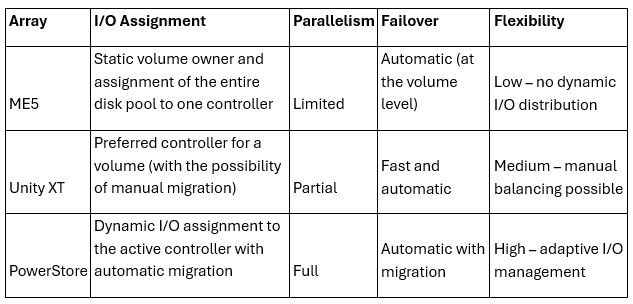
Comparison of approaches to I/O assignment
Conclusions
Although all three Dell arrays claim an active-active operating mode, their actual capabilities regarding the assignment of I/O operations to controllers are very different. ME5 offers basic availability with limited parallelism, Unity XT provides greater flexibility and partial load balancing, whereas PowerStore represents a full implementation of active-active with dynamic I/O assignment and enterprise-class scalability. Understanding these differences is crucial when designing IT infrastructure, especially where performance, availability, and scalability are of critical importance.
Would you like me to create a brief, bulleted summary of this article for easier scanning, or do you have any specific questions about these Dell array configurations?